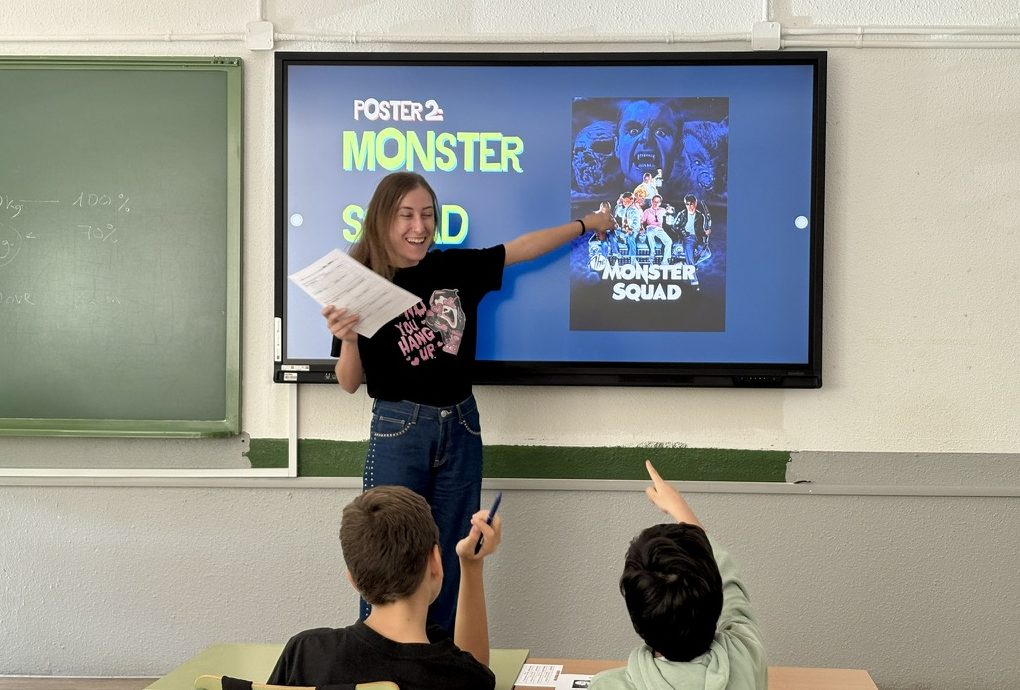
On 28 October 2026, team members Victoria Santamaría Ibor and Andrea Regueira Martín ran a Halloween-themed audiovisual literacy workshop with first-year ESO students at IES Pablo Gargallo in Zaragoza. Delivered entirely in English, the session was designed to help students improve their English alongside their film literacy. Students began by analysing horror film posters and clips, looking at how images, framing, and sound work together to build fear and expectation.
They then applied what they had learned to their own work, drafting an original scary scene in English and deciding which audiovisual elements it would include. One group imagined an explorer who enters an abandoned train station in the middle of nowhere, only for a ghost train to arrive and unload ghosts, zombies, and monsters. The scene would include a jump scare and its gloomy mood would be enhanced through the use of dark colours, decaying props and a scary soundtrack and sound effects, including a scream. The workshop is part of the group’s film literacy activities in local schools.
Students analysing horror film posters during the workshop.
Team members Andrea Regueira Martín and Andrés Buesa participated in the international conference Women Filmmakers and New Feminist Cinemas in France, Great Britain, and the USA in the 21st Century, held at the Cinémathèque de Toulouse and ENSAV on 21–23 October 2026. The conference is the second in a series of three organised as part of the ANR-funded FEMME project.
Andrea Regueira Martín presented her paper “Imperfect from Now On: Fulfillment Beyond Heteronormative Coupledom in Leticia Dolera’s Perfect Life” as part of a pre-constituted panel, “Romance Displaced: Women Filmmakers and Heterosexual Coupledom in the Messy 2020s,” alongside Catherine Fowler (University of Otago) and Fiona Handyside (University of Exeter). The panel was moderated by Eve Benhamou. The paper examines how Perfect Life (Movistar+/HBO, 2019–2021) stages the failure of heteronormative coupledom and imagines alternative structures of care beyond the nuclear family, situating the series within broader trends in contemporary representations of womanhood and connecting Dolera’s work to the transnational phenomenon of “feel-bad postfeminism” and the collapse of faith in coupledom’s affective promises.
Andrés Buesa presented his paper “Care on Set: Feminist Ethics and the Direction of Child Performers” in the Panel “Filmic Gaze and Directing Practices,” moderated by Cristelle Maury. Drawing on feminist ethics of vulnerability and care, the paper examines the ethical dimensions of directing child performers, taking the work of Chinese-American filmmaker Chloé Zhao as a case study, and interrogating how her collaborative methods in Songs My Brothers Taught Me (2015) and Hamnet (2025) model a more ethically attentive approach to working with young actors on screen.
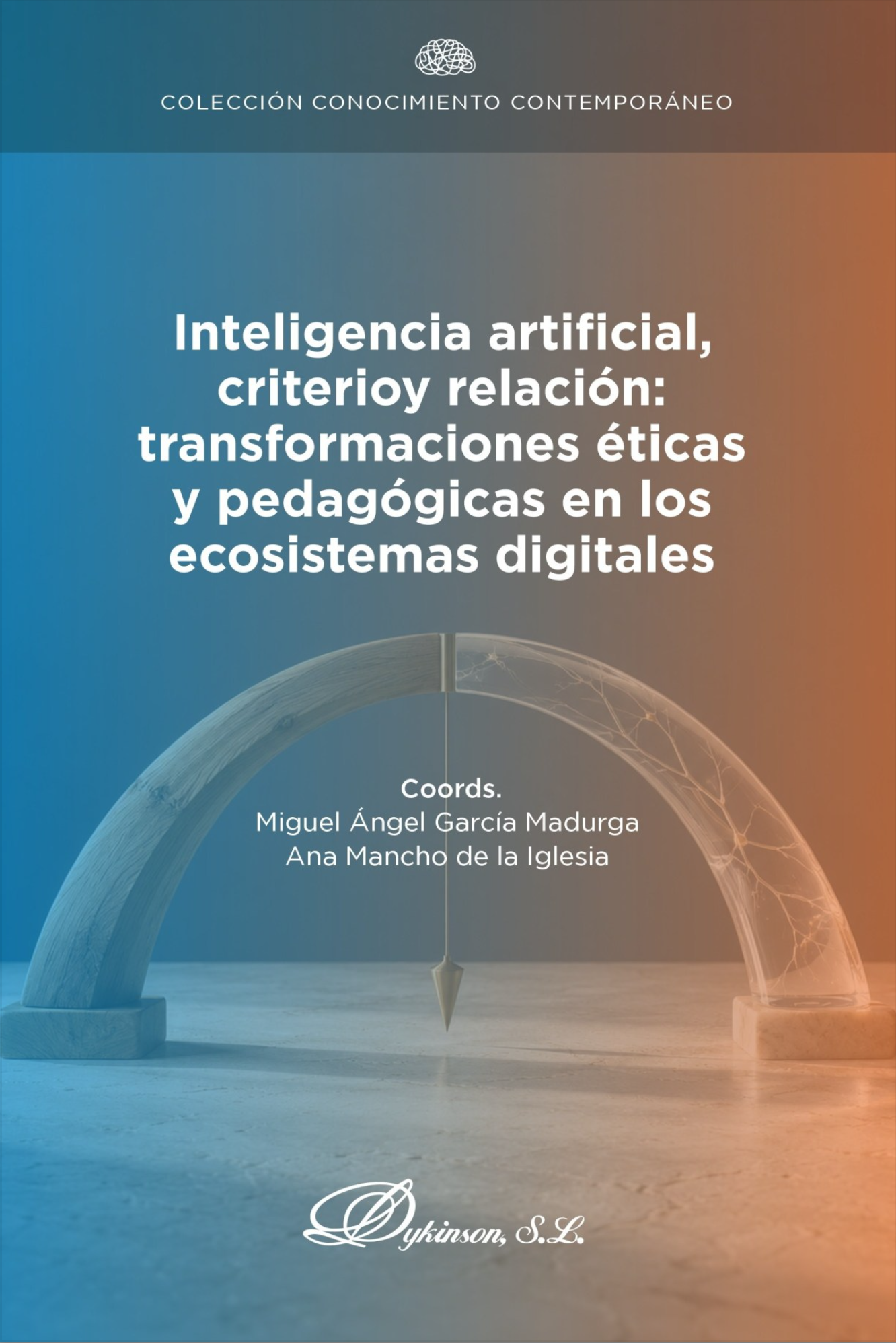
Associate team member Luis Freijo (King’s College London) has published a new book chapter in the context of the AGE-C: Ageing and Gender in European Cinema project (2023–2027). The chapter, titled “Envejecimiento y mundo rural en el cine español contemporáneo: un acercamiento de datos cuantitativo,” is included in the volume Inteligencia Artificial, criterio y relación: Transformaciones éticas y pedagógicas en los ecosistemas digitales (Dykinson, 2025), edited by Miguel Ángel García Madurga and Ana Mancho de la Iglesia (Universidad de Zaragoza). The volume gathers contributions presented at the XI Congreso Internacional Comunicación e Información Digital, held at the Universidad de Zaragoza in October 2025.
The chapter examines the representation of ageing in rural spaces in contemporary Spanish cinema, bringing together two topics of urgent public relevance in Spain: the ageing of the population and the depopulation and disproportionate ageing of rural areas, particularly in the centre of the country. Drawing on the AGE-C dataset, the chapter offers a quantitative analysis of ageing characters in rural settings, encompassing their diversity, and a thematic and generic reading of both fiction films and documentaries. The study concludes that Spanish cinema shows a growing concern with these two topics combined. The majority of ageing characters connected to rural space are heterosexual men between 60 and 75 years of age, with leisure and economic activities — particularly self-employed agricultural work — foregrounded, while vulnerable groups such as ageing women or people over 75 are less visible. Documentaries, by contrast, pay closer attention to themes of personal memory and caregiving.
The BIP is the first of its kind in the area of English Philology at the Universidad de Zaragoza. Developed in direct connection with the PerSpace research project, it aimed to bring the project’s theoretical frameworks — cinematic space, screen performance, mobility, and transnational cinema — into an international teaching and learning context, and to demonstrate the value of transferring research outcomes to the classroom.
Organised as a UNITA BIP, the programme drew on the UNITA university alliance network for student recruitment and faculty collaboration, while also involving expert teaching staff from non-UNITA Erasmus partner institutions and members of the research team. In total, 11 higher education institutions from 7 countries participated, with 35 students from disciplines as varied as English Studies, Modern Languages, Film Studies, Tourism, Graphic Design, Audiovisual Communication, and Chemistry — a disciplinary breadth that proved to be one of the programme’s greatest strengths.
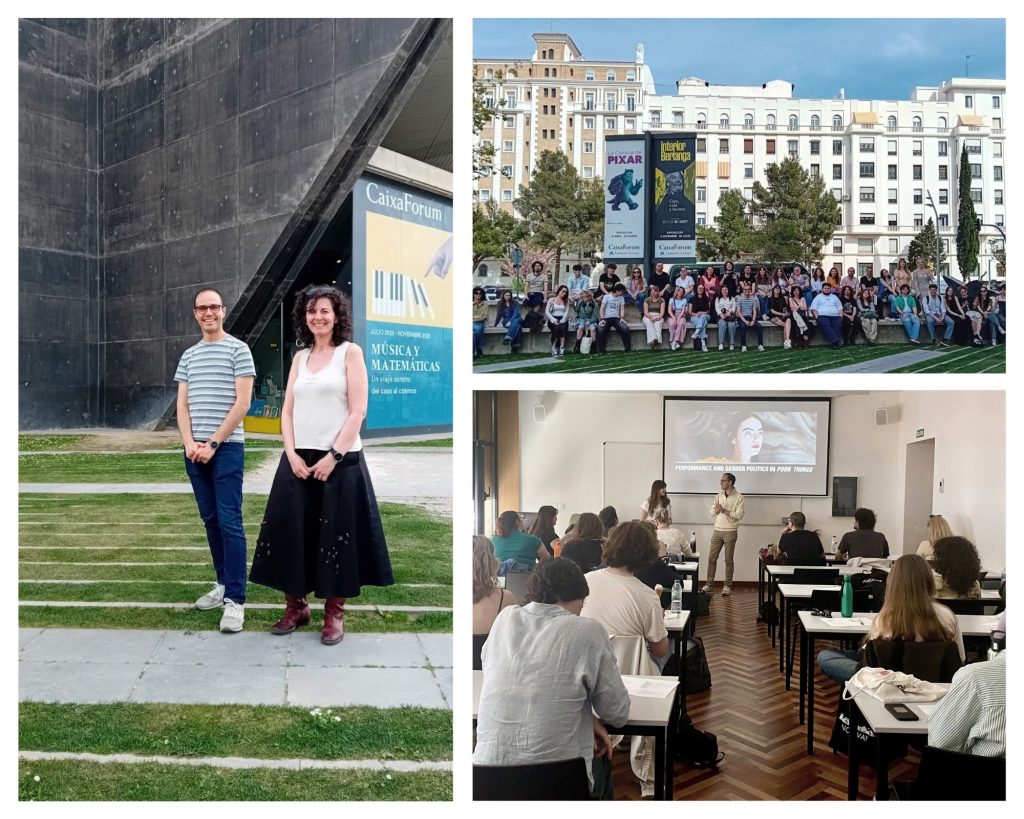
The programme combined 10 virtual hours with 30 in-person hours. The virtual component introduced students to key concepts and reference materials through flipped classroom methodology, teacher-produced videos, film screenings, synchronous sessions, and Moodle forums. The in-person phase included seminars, debates, and two external activities: attendance at screenings from the Ecozine environmental film festival and a visit to the Pixar exhibition at CaixaForum Zaragoza. Assessment was based on tasks completed during the virtual phase, participation in in-person sessions, and a final essay.
The results confirmed the programme’s success on multiple fronts: strong critical engagement with film space and performance across disciplines; development of linguistic and intercultural competence in English; and environmental awareness raised through the Ecozine screenings. Student interest was high enough to generate waiting lists at several partner universities, and both students and faculty expressed enthusiasm for future editions.
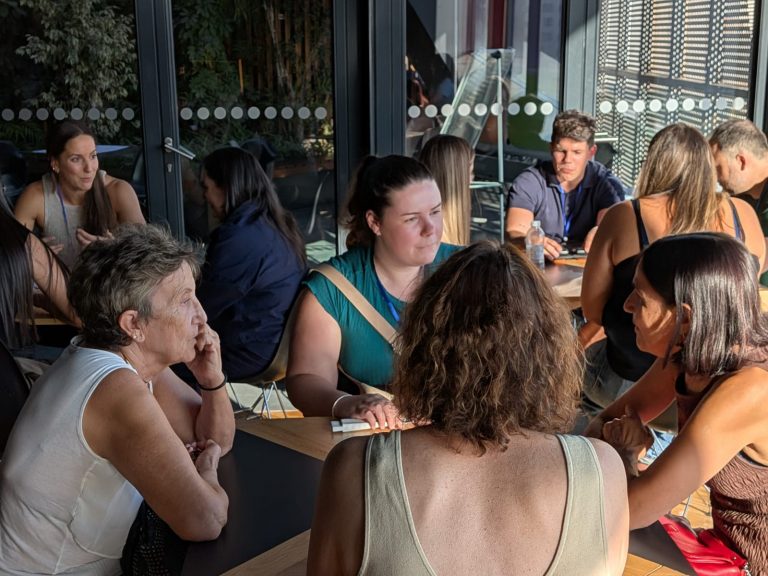
On 25 September 2026, predoctoral researchers Elena Velilla Gonzalvo and Carlota Fernández Espiago participated in La Noche de la Investigación (European Researchers’ Night) at CaixaForum Zaragoza, an event aimed at bringing research and researchers closer to the general public.
As part of the programme, they took part in the “Speed Dating” activity, an interactive format in which members of the public moved between different tables and had the opportunity to ask researchers questions about their work. The activity provided an informal and engaging space for communicating research beyond the academic context, encouraging dialogue between researchers and citizens and contributing to the transfer of academic knowledge.
Doctoral candidate Elena Velilla at the speed dating event
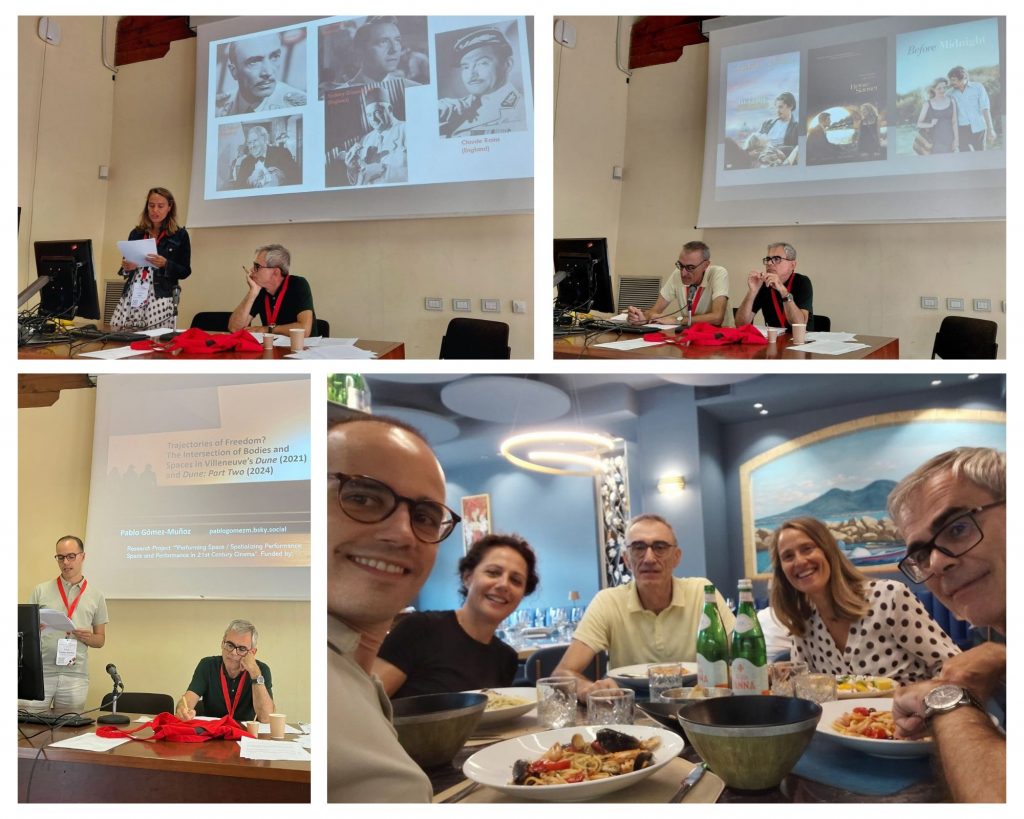
Some of our team members put together a panel for the 36th biennial EAAS conference. The conference, titled “1776–2026: Visions of Freedom,” took place at the University of Bologna, Italy from September 1-4, 2026.
The panel, titled Performing Freedom in Space from Classical Hollywood to Contemporary Cinema, featured contributions by Celestino Deleyto, Costanza Salvi, Pablo Gómez Muñoz and Sara Pesce, and it was chaired by Michele Fadda (Alma Mater Studiorum – Università di Bologna).
The nature and ideology of the notion of freedom have been a constant preoccupation in the history of U.S. cinema from its beginnings in silent films. The general desire to modernize social thinking was the backbone of the ideology promoted by Hollywood in the classical era, when a transnational concept of taste based on morally inoffensive, ideologically neutral messages revolved around wide concepts of democracy, tolerance, and freedom. In the following historical phases, specific genres, constructions of mise en scène, filmic space, and performing traditions have contributed to what we might describe as the stylistics of “American” freedom. This panel offers a formal approach to the study of such a cinematic configuration, namely, the analysis of “performance in/of space”, that is, the way in which actors’ performances and mise en scène combine to produce meanings in films.
Pesce articulates a theoretical framework re-examining a long tradition of film analysis that treats human figures as inseparable from their environment, drawing on acting styles and the meanings attached to the star persona in contemporary Hollywood. One Battle After Another (2025) reveals how the interface between performance and mise-en-scène functions as a privileged vehicle for conveying stratified cultural conceptions of freedom. Deleyto crosses the Atlantic to explore how the close interconnection between performance and space speaks to national and transnational notions of freedom within present-day ideas of Europe in Before Midnight (2013). In this case, certain types of acting combine with the use of real locations to construct a filmic space that speaks, from a hybrid American-European perspective, to debates around the present and the future of the EU. Salvi examines the ambivalences of the nation’s founding ideals, observing how Humphrey Bogart’s performance in Casablanca (1942) constructs a concept of freedom for its turbulent times. While Bogart embodies the national ideology of individualism, Rick’s Bar represents a cosmopolitan view that challenges the notion of unlimited freedom. The internal dynamics between space and character reveal how the film reverses the traditional treatment of the primacy of the individual over the environment. Gómez argues that Denis Villeneuve’s films Dune (2021) and Dune: Part Two (2024) develop a discourse that treads a fine line between freedom and oppression, as the narrative moves between the cosmopolitan disposition of the protagonist, Paul Atreides (Timothée Chalamet), and his messianic impulses. The relationship between the representation of spaces and actors’ performances bring the contrast between the liberatory and messianic dimensions of the films to the surface.
Paper Titles:
Sara Pesce: One Battle After Another. Layered Articulations of American Freedom through Space and Performance.
Celestino Deleyto: Performing the Mediterranean: The Actor, the Look, Space and Place in Before Midnight
Costanza Salvi: Humphrey Bogart and Rick’s Café Américain: A Paradigm to Read American Freedom in Casablanca (Michael Curtiz 1942)
Pablo Gómez Muñoz: Trajectories of Freedom? The Intersection of Bodies and Spaces in Villeneuve’s Dune (2021) and Dune: Part Two (2024)
Panelists and chair celebrating a job well done.
This research was supported by project PID2021-123836NB-I00, funded by MCIN/AEI, and project H23_23R, funded by the Government of Aragón.
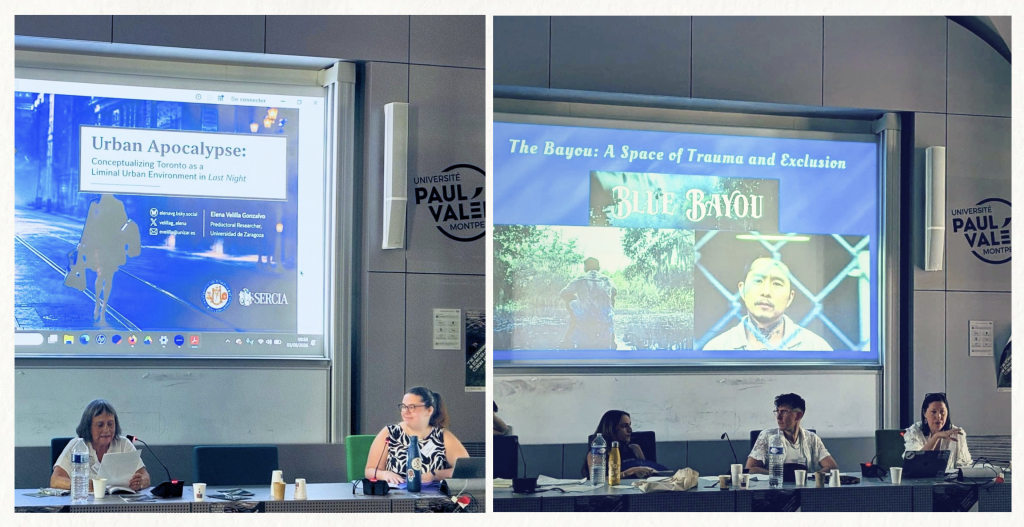
Team members Manuela Ruiz and Elena Velilla participated in the 26th SERCIA Conference, held at the Site Saint-Charles in Montpellier, France, from 2 to 4 September 2026. The conference, organised by the Société pour l’Enseignement et la Recherche du Cinéma Anglophone, focused on the theme “The Environment in English-Language Cinema and Series.”
Manuela Ruiz presented her paper “Lake Reflections: Landscapes of Affect and Displacement in Justin Chon’s Blue Bayou (2021) and Mikko Mäkelä’s A Moment in the Reefs” as part of the panel “Bayous and Still Waters.” The paper examines two contemporary migration films from an ecocritical perspective, arguing that their central natural landscapes — a Louisiana bayou and a Finnish lake — function simultaneously as spaces of trauma and cross-border intimacy, and as real environments of ecological fragility. The analysis situates both films within the contexts of international adoption and refugee crises to explore how cinematic landscape constructs transnational affect and displacement.
Elena Velilla presented her paper “Urban Apocalypse: Conceptualizing Toronto as a Liminal Urban Environment in Last Night,” which analyses Don McKellar’s 1998 film through a spatial and cosmopolitan lens. The paper argues that the film constructs Toronto as a liminal urban environment shaped by shifting borders and ephemeral encounters, tracing how the city’s social and environmental systems gradually disintegrate as the narrative approaches its apocalyptic conclusion.
Elena Velilla and Manuela Ruiz presenting their papers at the SERCIA conference.
María del Mar Azcona, IP of the project, has been interviewed for the book Educar la mirada: Ciclo de entrevistas a expertos de la industria del cine, festivales de cine educativo y centros productores de cine escolar, coordinated by Fernando Yarza.
The interviews were conducted in the framework of the PISOC project “Educa-acción! Cine y Educación para la Transformación Social”, developed around the first and second editions of the Festival de Cine Escolar of the Facultad de Educación of the Universidad de Zaragoza. The volume brings together interviews with experts from the film industry, educational film festivals, and schools involved in audiovisual production, all united by a commitment to film literacy as a tool for critical citizenship. Other contributors include Miguel Ángel Lamata (screenwriter and film director), José Manuel Herráiz (producer, director and screenwriter, Albella Audiovisual), Ángel Gonzalvo (coordinator of the Un Día de Cine programme, Government of Aragón), and representatives of educational film festivals including Ecozine, Cine y Salud, Fescila, and the International Youth Film Festival Plasencia Encorto, among others.
In her interview, Azcona reflects on how cinema functions as an ideological vehicle rather than mere entertainment, arguing that learning to read film is inseparable from developing critical thinking. She describes the four film analysis courses taught in the English Studies degree at the Universidad de Zaragoza and emphasises that audiovisual literacy equips students to identify and question the ideological discourses embedded in the images that surround them daily. On the role of the university beyond its walls, she highlights the research project’s ongoing outreach activities in schools, including sessions exploring the sexualised representation of female characters in animation, designed both to raise awareness among students and to provide teachers with tools they can replicate independently. Asked about the evolution of her students over twenty years of teaching, she notes that concepts like patriarchy are now part of their everyday vocabulary — though the deeper analytical work of reading texts critically, she argues, remains as challenging as ever.
“From the very first day we insist that cinema, as part of popular culture, not only reflects the society we live in, but also helps to create it. Films represent patterns that then become part of us and of the way we behave in response to some of the things that happen to us. Learning to read images and audiovisual texts teaches us to identify key elements of mise-en-scène, framing, editing and sound — and at the same time to reflect on their narrative and ideological implications. In our courses, we always stress that in a film, what is not said and not shown is just as important as what is.” — María del Mar Azcona
On 22 May 2026, team members Andrea Regueira, Claudia Aguas, and Carmen Navarro organised an audiovisual literacy workshop with first-year Bachillerato students at Colegio Santa Ana in Zaragoza. Students explored and analysed scenes from Billy Elliot (Stephen Daldry, 2000), examining key elements of film language including camera angles, framing, sound design, mise-en-scène, and costume to reflect on issues of class, gender and parental expectations.
The workshop is part of the group’s ongoing programme of film literacy activities in local schools, which combines the teaching of English as a foreign language with the development of students’ critical engagement with film and media.
“Nos han enseñado a analizar una escena de la película Billy Elliot y hemos aprendido que nada se deja al azar: movimientos de cámara, posición, puesta en escena, vestuario… todo tiene un significado y un propósito.”
— Colegio Santa Ana
From 13 to 17 April 2026, the Universidad de Zaragoza hosted the in-person phase of the Blended Intensive Programme (BIP) “Space and Performance in the Cinema,” organised within the UNITA university alliance. The BIP was organised by team members Pablo Gómez-Muñoz and María del Mar Azcona Montoliu, with the support of the Erasmus+ programme and the Institute for Employment, Digital Society and Sustainability (IEDIS).
The course offered an introduction to the study of cinema through the lens of cinematic space and its relationship with real and imagined spaces. Drawing on examples from American, European, and Australian cinema, it explored themes including mobility, gender, intimacy, transnational dynamics, and urban spaces. Sessions took place primarily at the Facultad de Filosofía y Letras, with two additional activities outside the university: screenings at the Ecozine environmental film festival and a visit to the Pixar exhibition at CaixaForum Zaragoza.
The BIP brought together 34 students from universities across the UNITA alliance — Beira (Portugal), Pau and Savoie Mont Blanc (France), Turin (Italy), Timișoara and Brașov (Romania) — and from other European partner institutions: the University of Galway (Ireland) and the Université Paul Valéry Montpellier (France).
The teaching team included Rob Stone (University of Birmingham), Conn Holohan (University of Galway), Martha Shearer (University College Dublin), David Roche (Université Paul Valéry Montpellier), Alberto Spadafora (University of Turin), Ioana Dorobanțu-Gordon (West University of Timișoara), Bogdan Popa (Transilvania University of Brașov), Celestino Deleyto, and Julia Echeverría (Universidad de Zaragoza).



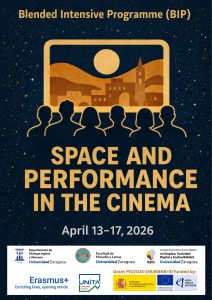 From 13 to 17 April 2026, the Universidad de Zaragoza hosted the in-person phase of the Blended Intensive Programme (BIP) “Space and Performance in the Cinema,” organised within the UNITA university alliance. The BIP was organised by team members Pablo Gómez-Muñoz and María del Mar Azcona Montoliu, with the support of the Erasmus+ programme and the Institute for Employment, Digital Society and Sustainability (IEDIS).