Team members Andrea Regueira Martín and Andrés Buesa participated in the international conference Women Filmmakers and New Feminist Cinemas in France, Great Britain, and the USA in the 21st Century, held at the Cinémathèque de Toulouse and ENSAV on 21–23 October 2026. The conference is the second in a series of three organised as part of the ANR-funded FEMME project.
Andrea Regueira Martín presented her paper “Imperfect from Now On: Fulfillment Beyond Heteronormative Coupledom in Leticia Dolera’s Perfect Life” as part of a pre-constituted panel, “Romance Displaced: Women Filmmakers and Heterosexual Coupledom in the Messy 2020s,” alongside Catherine Fowler (University of Otago) and Fiona Handyside (University of Exeter). The panel was moderated by Eve Benhamou. The paper examines how Perfect Life (Movistar+/HBO, 2019–2021) stages the failure of heteronormative coupledom and imagines alternative structures of care beyond the nuclear family, situating the series within broader trends in contemporary representations of womanhood and connecting Dolera’s work to the transnational phenomenon of “feel-bad postfeminism” and the collapse of faith in coupledom’s affective promises.
Andrés Buesa presented his paper “Care on Set: Feminist Ethics and the Direction of Child Performers” in the Panel “Filmic Gaze and Directing Practices,” moderated by Cristelle Maury. Drawing on feminist ethics of vulnerability and care, the paper examines the ethical dimensions of directing child performers, taking the work of Chinese-American filmmaker Chloé Zhao as a case study, and interrogating how her collaborative methods in Songs My Brothers Taught Me (2015) and Hamnet (2025) model a more ethically attentive approach to working with young actors on screen.
Some of our team members put together a panel for the 36th biennial EAAS conference. The conference, titled “1776–2026: Visions of Freedom,” took place at the University of Bologna, Italy from September 1-4, 2026.
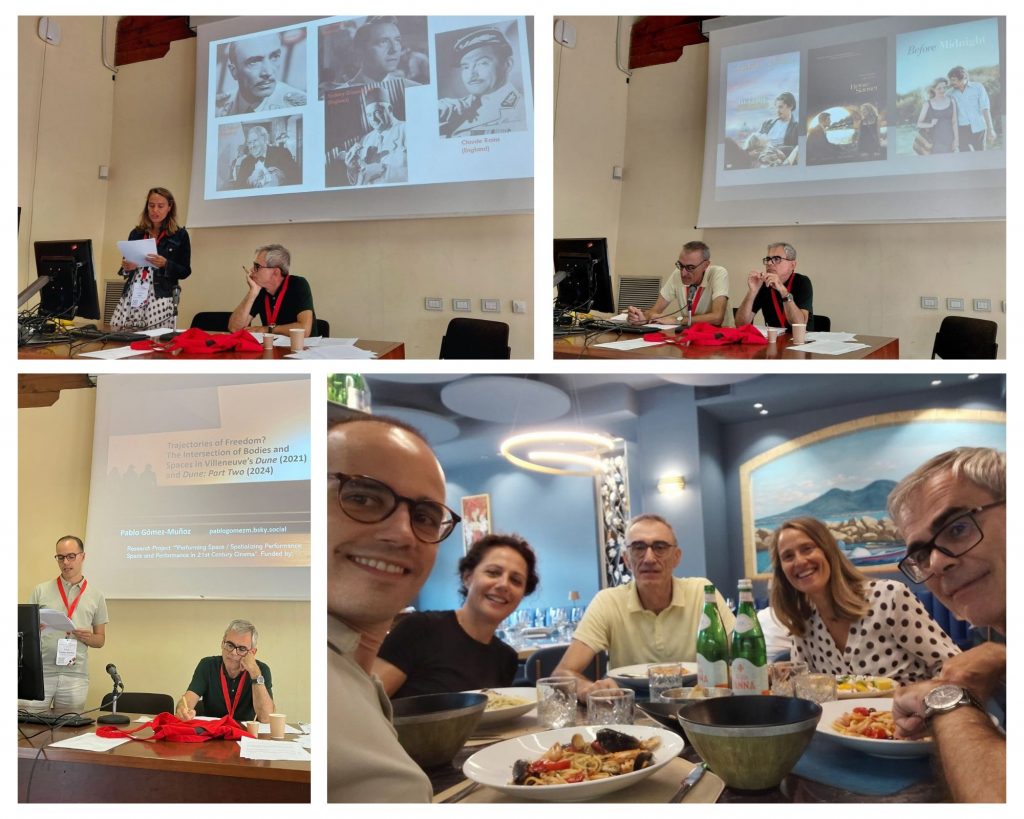
The panel, titled Performing Freedom in Space from Classical Hollywood to Contemporary Cinema, featured contributions by Celestino Deleyto, Costanza Salvi, Pablo Gómez Muñoz and Sara Pesce, and it was chaired by Michele Fadda (Alma Mater Studiorum – Università di Bologna).
The nature and ideology of the notion of freedom have been a constant preoccupation in the history of U.S. cinema from its beginnings in silent films. The general desire to modernize social thinking was the backbone of the ideology promoted by Hollywood in the classical era, when a transnational concept of taste based on morally inoffensive, ideologically neutral messages revolved around wide concepts of democracy, tolerance, and freedom. In the following historical phases, specific genres, constructions of mise en scène, filmic space, and performing traditions have contributed to what we might describe as the stylistics of “American” freedom. This panel offers a formal approach to the study of such a cinematic configuration, namely, the analysis of “performance in/of space”, that is, the way in which actors’ performances and mise en scène combine to produce meanings in films.
Pesce articulates a theoretical framework re-examining a long tradition of film analysis that treats human figures as inseparable from their environment, drawing on acting styles and the meanings attached to the star persona in contemporary Hollywood. One Battle After Another (2025) reveals how the interface between performance and mise-en-scène functions as a privileged vehicle for conveying stratified cultural conceptions of freedom. Deleyto crosses the Atlantic to explore how the close interconnection between performance and space speaks to national and transnational notions of freedom within present-day ideas of Europe in Before Midnight (2013). In this case, certain types of acting combine with the use of real locations to construct a filmic space that speaks, from a hybrid American-European perspective, to debates around the present and the future of the EU. Salvi examines the ambivalences of the nation’s founding ideals, observing how Humphrey Bogart’s performance in Casablanca (1942) constructs a concept of freedom for its turbulent times. While Bogart embodies the national ideology of individualism, Rick’s Bar represents a cosmopolitan view that challenges the notion of unlimited freedom. The internal dynamics between space and character reveal how the film reverses the traditional treatment of the primacy of the individual over the environment. Gómez argues that Denis Villeneuve’s films Dune (2021) and Dune: Part Two (2024) develop a discourse that treads a fine line between freedom and oppression, as the narrative moves between the cosmopolitan disposition of the protagonist, Paul Atreides (Timothée Chalamet), and his messianic impulses. The relationship between the representation of spaces and actors’ performances bring the contrast between the liberatory and messianic dimensions of the films to the surface.
Paper Titles:
Sara Pesce: One Battle After Another. Layered Articulations of American Freedom through Space and Performance.
Celestino Deleyto: Performing the Mediterranean: The Actor, the Look, Space and Place in Before Midnight
Costanza Salvi: Humphrey Bogart and Rick’s Café Américain: A Paradigm to Read American Freedom in Casablanca (Michael Curtiz 1942)
Pablo Gómez Muñoz: Trajectories of Freedom? The Intersection of Bodies and Spaces in Villeneuve’s Dune (2021) and Dune: Part Two (2024)
Panelists and chair celebrating a job well done.
This research was supported by project PID2021-123836NB-I00, funded by MCIN/AEI, and project H23_23R, funded by the Government of Aragón.
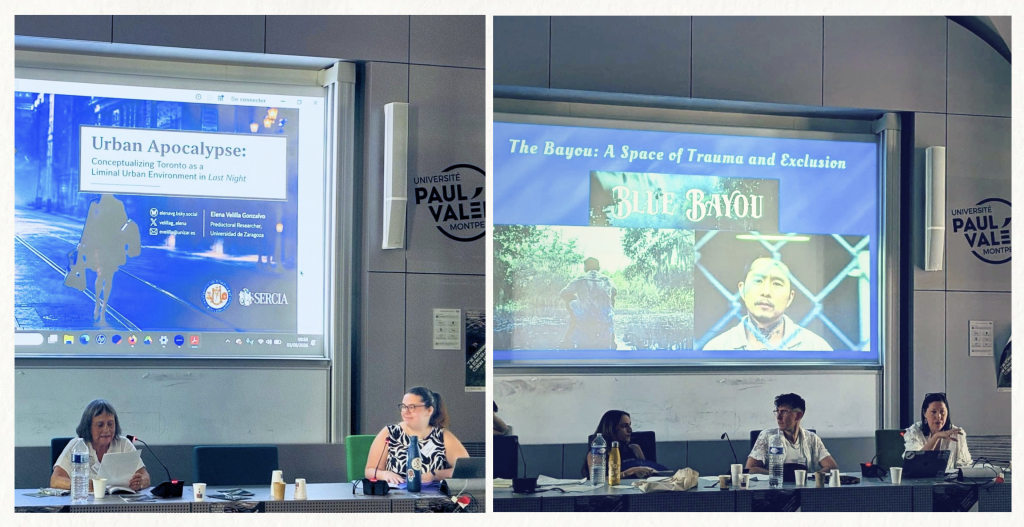
Team members Manuela Ruiz and Elena Velilla participated in the 26th SERCIA Conference, held at the Site Saint-Charles in Montpellier, France, from 2 to 4 September 2026. The conference, organised by the Société pour l’Enseignement et la Recherche du Cinéma Anglophone, focused on the theme “The Environment in English-Language Cinema and Series.”
Manuela Ruiz presented her paper “Lake Reflections: Landscapes of Affect and Displacement in Justin Chon’s Blue Bayou (2021) and Mikko Mäkelä’s A Moment in the Reefs” as part of the panel “Bayous and Still Waters.” The paper examines two contemporary migration films from an ecocritical perspective, arguing that their central natural landscapes — a Louisiana bayou and a Finnish lake — function simultaneously as spaces of trauma and cross-border intimacy, and as real environments of ecological fragility. The analysis situates both films within the contexts of international adoption and refugee crises to explore how cinematic landscape constructs transnational affect and displacement.
Elena Velilla presented her paper “Urban Apocalypse: Conceptualizing Toronto as a Liminal Urban Environment in Last Night,” which analyses Don McKellar’s 1998 film through a spatial and cosmopolitan lens. The paper argues that the film constructs Toronto as a liminal urban environment shaped by shifting borders and ephemeral encounters, tracing how the city’s social and environmental systems gradually disintegrate as the narrative approaches its apocalyptic conclusion.
Elena Velilla and Manuela Ruiz presenting their papers at the SERCIA conference.